
AI and the Future of Project Management in Qatar
AI‑powered project management is rapidly becoming a strategic enabler for organisations in Qatar as they navigate ever more complex projects, tighter delivery expectations, and higher demands for governance and transparency. In a region where public and private stakeholders pursue digital maturity at pace, traditional project tools are evolving into intelligent systems that guide decisions, support documentation, and reduce administrative burden.
This evolution is particularly relevant in the context of Qatar National Vision 2030, which emphasises digital transformation, innovation, and a knowledge‑based economy as cornerstones of long‑term sustainable development. Qatar’s national digital agenda includes a strong focus on adopting advanced technologies, including artificial intelligence, to improve how government and industry operate and deliver services.
This blog explores how AI is shaping the future of project management and how QPunch applies AI in practical ways to support project teams.

From Static Tools to Intelligent Project Platforms
Historically, project management tools focused on documentation and tracking. Gantt charts, task lists, and reports helped teams visualize plans, but they required constant manual updates and interpretation. As projects scaled, so did the administrative burden on project managers.
AI introduces intelligent support that helps users work more efficiently within the system. Instead of spending time navigating features or drafting content from scratch, teams receive guidance directly where they work, improving both speed and accuracy. This evolution shifts project management platforms from passive tracking tools into active systems that support daily decision making. This shift is especially important for organizations managing multiple projects, mixed methodologies, and diverse user roles.
Key Areas Where AI Is Transforming Project Management
1. Smarter Onboarding and User Guidance
One of the biggest challenges in project management software adoption is onboarding. Teams often struggle to understand where to start, how features work, or how to configure the system correctly.
AI assistants can now provide instant, context-aware guidance inside the platform. Users can ask questions in natural language and receive clear explanations without leaving the system or relying on documentation or support tickets. The AI scans the system’s help files to surface the right guidance immediately. This reduces time spent searching for help, minimizes support requests, and enables teams to adopt the system faster and more confidently.
2. Faster Decision Support
Project managers are required to make decisions quickly, often with incomplete information. AI helps by surfacing relevant insights, highlighting trends, and pointing users to the right data or features within the system. Rather than replacing judgment, AI supports it by reducing the time spent searching for information.
3. Reduced Administrative Overhead
Many project management activities are repetitive: updating statuses, checking dependencies, generating reports, and verifying configurations. AI can streamline these activities by guiding users through processes and reducing errors caused by incorrect setup or missed steps. This allows project managers to focus more on stakeholder management and less on system navigation.
4. Improved Consistency Across Projects
As organizations grow, maintaining consistency across projects becomes difficult. AI-driven guidance helps ensure that users follow standard processes, templates, and configurations, while still allowing flexibility where needed. This balance between control and adaptability is critical for enterprise and PMO environments.
5. Continuous Learning Inside the Tool
Unlike traditional help files that sit outside the system, AI assistants learn how users interact with the platform. Over time, guidance becomes more relevant, helping teams work more efficiently without constant retraining.
Qatar: Government AI Initiatives
Qatar’s national strategy explicitly promotes digital transformation and AI adoption as part of its economic diversification and knowledge economy goals. The Qatar National Vision 2030 and Digital Agenda 2030 both emphasise leveraging advanced technologies to enhance government services, expand digital capabilities, and build local talent ecosystems.
In support of this, the GovAI Program, which is a national initiative led by the Ministry of Communications and Information Technology, accelerates AI adoption across government entities and empowers innovative digital projects tailored to improve public services and operational efficiency. Recent partnerships with global technology leaders under the GovAI Programme highlight Qatar’s commitment to fostering AI‑enabled solutions aligned with the Digital Agenda 2030 and Qatar National Vision 2030.
These efforts reflect a broader national push towards becoming a regional hub for AI innovation and digital excellence, showing how intelligent tools and AI‑augmented processes like those within QPunch fit into the country’s strategic objectives.
How QPunch Aligns With Qatar’s Strategic Goals:
QPunch integrates AI in ways that directly support how project teams in Qatar work, focusing on usability, governance, and efficiency rather than automation for its own sake. AI in QPunch is designed to assist, not replace, project managers or team members. Decisions, stakeholder management, and leadership remain in human responsibilities. AI simply removes friction by helping users write better content faster and understand the system more easily.
1. AI-Assisted Writing within QPunch
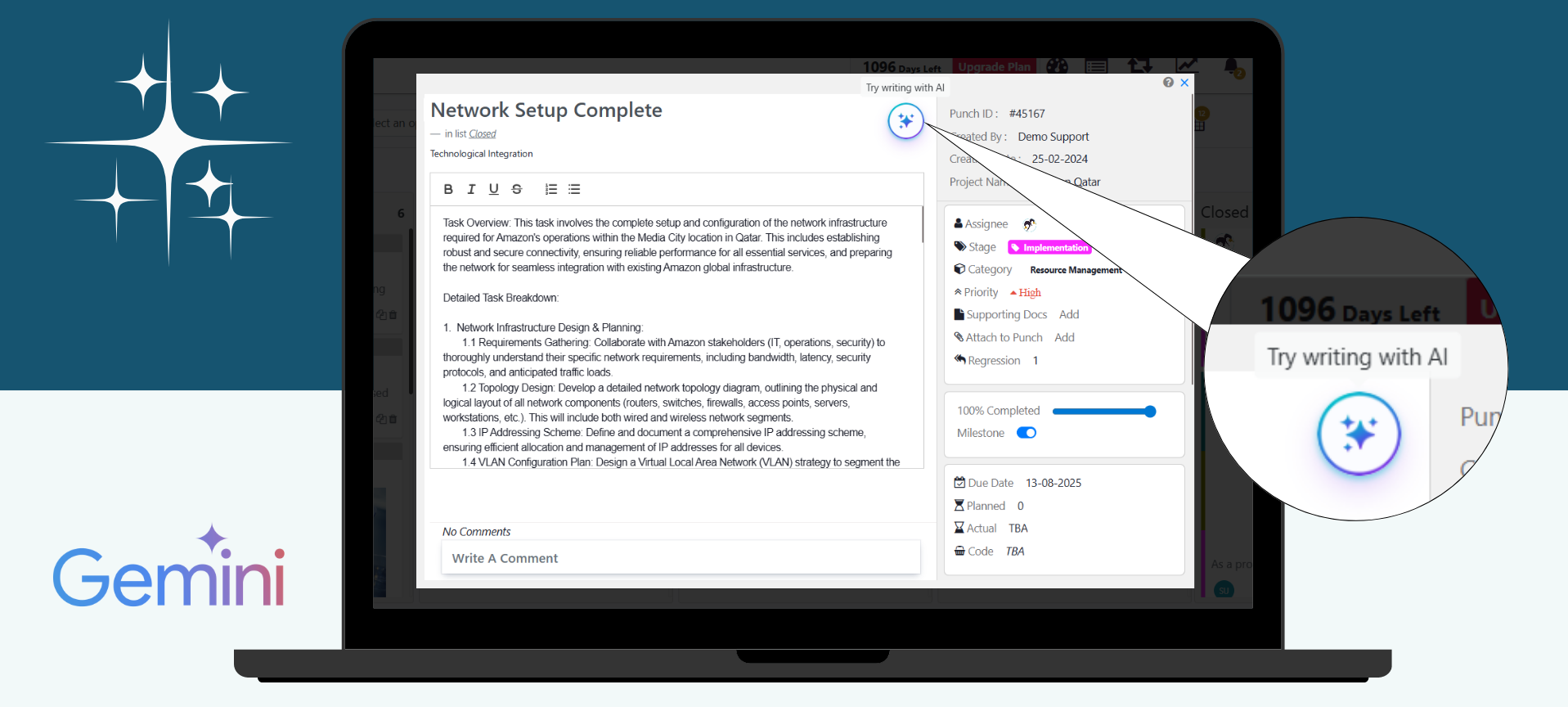
With the Try Writing with AI feature, users can generate clear, structured project content directly within the platform. Powered by Google Gemini, this capability assists users in drafting project descriptions, task descriptions, user stories, project updates, and other supporting documentation. Instead of starting from a blank page, teams receive AI assisted suggestions that improve clarity, consistency, and readability while saving time. This is especially valuable for organizations managing formal documentation standards across multiple projects, where consistency and accuracy are critical. This is especially valuable for organizations managing formal documentation standards across multiple projects.
2. QBuddy: Built in AI-Assistant
Within QPunch, AI is embedded through QBuddy, an intelligent assistant designed to support users directly inside the platform. QBuddy helps users understand features, navigate workflows, and get instant answers to common questions without interrupting their work. Teams can ask questions in natural language and receive immediate answers based on QPunch documentation and system knowledge. This approach improves onboarding, reduces dependency on training sessions, and helps teams get value from QPunch faster. QBuddy does not make decisions for project managers. Instead, it empowers them with clarity, guidance, and faster access to information.
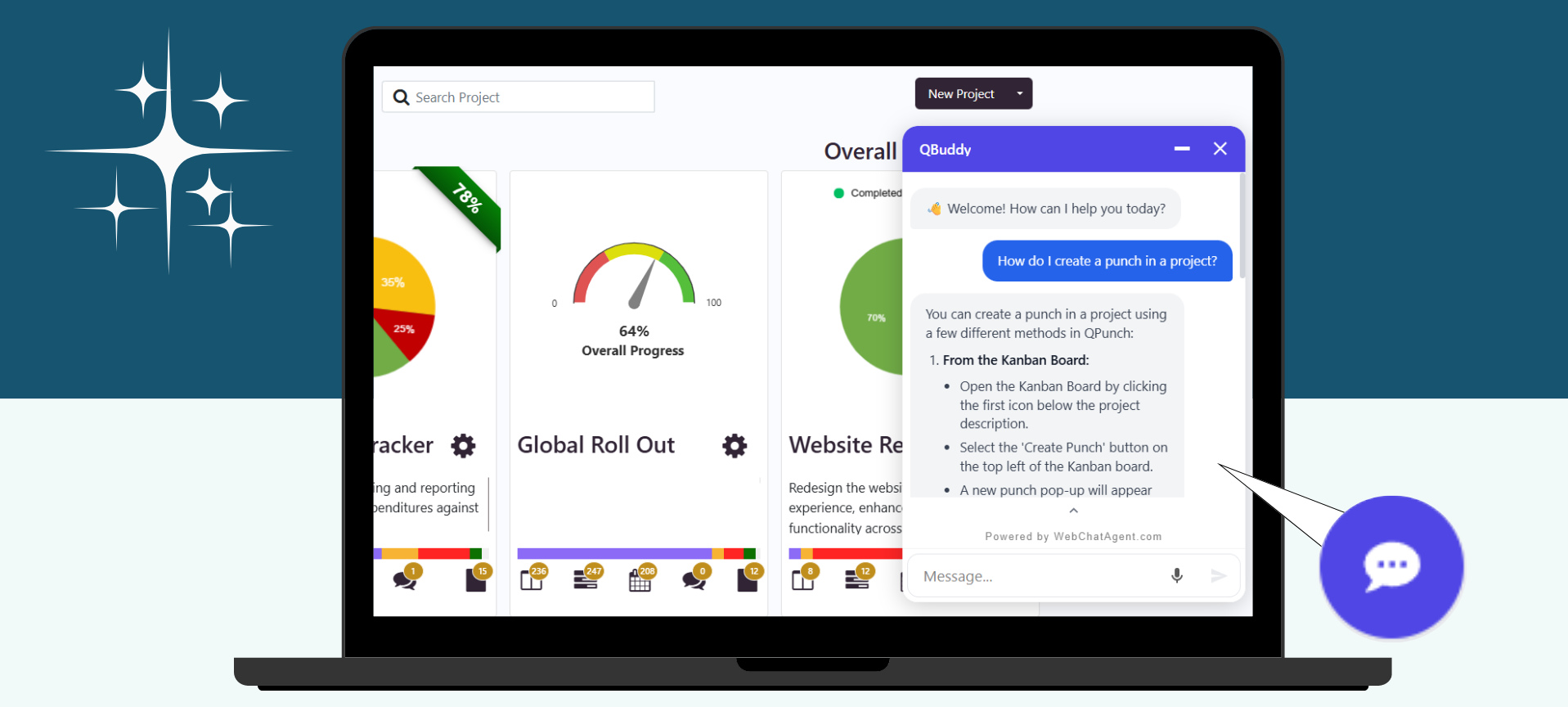
QPunch already integrates AI to support project teams at multiple touchpoints, providing practical assistance rather than replacing human decision-making. The platform combines QBuddy, an embedded intelligent assistant, with AI-assisted writing, helping teams generate clear, structured project content, understand workflows, and navigate the system efficiently. These features ensure faster onboarding, consistent documentation, and reduced administrative effort across projects.
AI in Action: The QPunch User Journey
Building on these capabilities, QPunch is now moving towards a full project lifecycle AI roadmap, designed to align with how digital projects are planned, executed, and governed in Qatar.
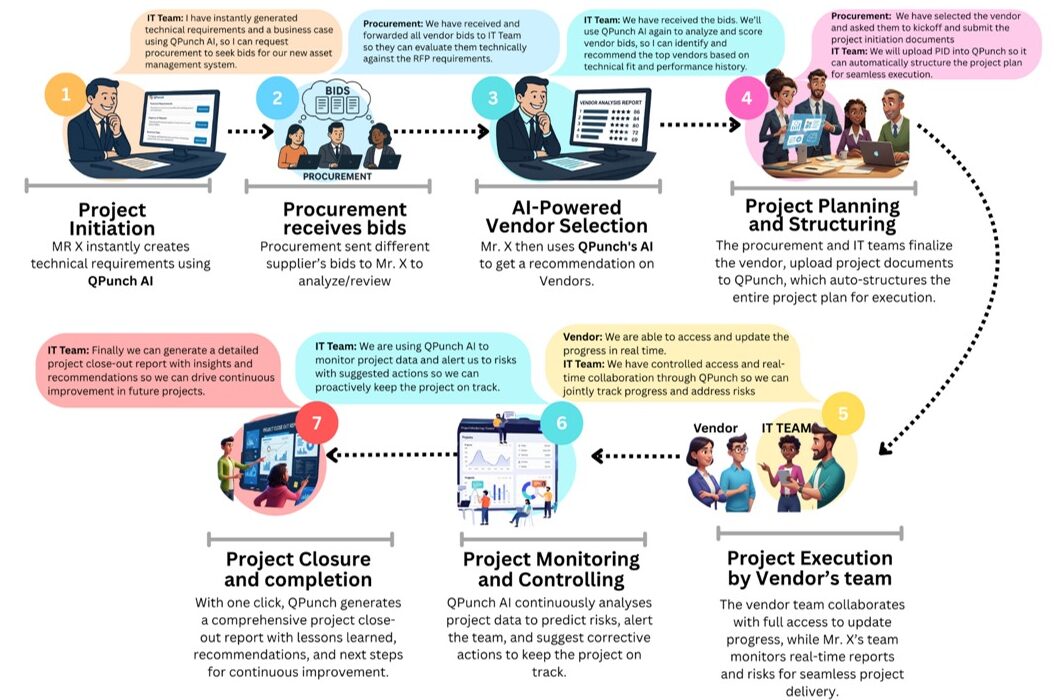
The above illustrates the QPunch User Journey and how AI is implemented in every phase of the project, from initiation to closure, in practical ways:
1. Project Initiation: AI instantly generates technical requirements and business case outlines, kick‑starting the discovery phase.
2. Procurement Support: Procurement teams can send structured requirements to vendors and review responses efficiently.
3. AI‑powered Vendor Selection: QPunch’s AI recommends vendors based on data‑driven analysis.
4. Project Planning & Structuring: AI auto‑structures project plans from uploaded documents, reducing manual setup.
5. Execution & Collaboration: Real‑time collaboration between vendor teams and internal IT is enabled with live updates.
6. Project Monitoring & Controlling: Continuous risk detection and suggested corrective actions keep delivery on track.
7. Project Closure & Reporting: With one click, AI generates comprehensive closure reports with insights for future improvement.
This roadmap reflects QPunch’s vision of creating a fully AI-assisted PM lifecycle, ensuring project teams in Qatar can work efficiently, consistently, and in line with local governance and digital transformation requirements.
Final Thoughts
In conclusion, Artificial Intelligence in QPunch is designed to enhance, not replace, human expertise. By embedding intelligent guidance, real-time insights, and AI-assisted content creation into the platform, teams can focus on decision-making, collaboration, and delivery while the system reduces friction and ensures consistency. With QBuddy and AI-assisted writing as the foundation, QPunch is now evolving towards a comprehensive AI-powered project management lifecycle. This approach aligns with Qatar’s strategic objectives for digital transformation, providing project teams with tools that support the entire journey from initiation to closure.
As projects in Qatar become more complex and expectations around governance, visibility, and compliance rise, AI-driven support will play an increasingly important role in helping teams work smarter, faster, and more confidently.
Talk to our experts today! Send us an email on support@qpunch.co or contact us.
Address On Maps
Ready To Get Started with Smart Project Management?